
CTEM: Turning Cloud Bucket Hijacking Risks into Actionable Exposure Management
CTEM turns the global namespace bucket hijacking risk into continuous discovery, prioritization, and remediation — keeping cloud data safe from exfiltration.
CTEM: Turning Cloud Bucket Hijacking Risks into Actionable Exposure Management
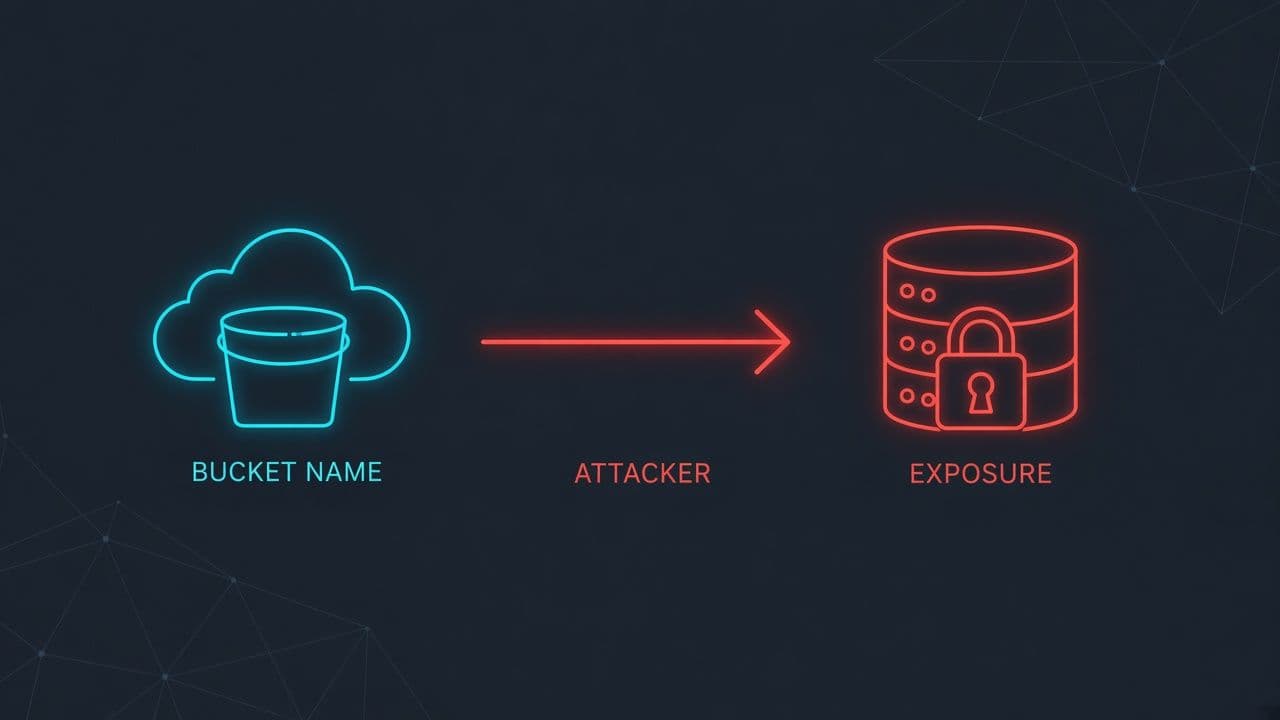
Attackers no longer need to steal credentials; they can simply guess a globally unique bucket name and redirect your cloud data streams to their own storage.
The Global Namespace Risk: How Bucket Hijacking Works

An attacker can claim the name before the owner does.
Why Name Uniqueness Creates a Blind Spot

The namespace is global, so the name itself is the exposure.
Cloud storage buckets are identified by a globally unique name. Unlike internal hostnames that can be scoped to a VPC, a bucket name must be unique across the entire provider’s namespace. This means an attacker who can predict or brute‑force a name can create a bucket with the same identifier in their own account and, if the victim’s application is misconfigured to stream data to that name, the data flows straight into the attacker’s storage. Because the name itself is the trust boundary, traditional network‑level controls (firewalls, VPC peering) see nothing abnormal—the traffic looks like legitimate cloud‑to‑cloud communication.
Real‑World Implications for Multi‑Cloud Environments
When organizations use multiple clouds, the risk multiplies. A bucket named log-archive-prod might exist in AWS, but an attacker could create log-archive-prod in GCP and poison a misconfigured cross‑cloud backup job. The global namespace also aids automated scanning tools: attackers can enumerate common prefixes and test for write permissions across platforms, turning a simple name guess into a data exfiltration vector that bypasses many CSP‑native security controls.
Why Traditional Vulnerability Management Falls Short

A server scan does not see an exposed bucket.
Static Scans Miss Ephemeral Cloud Assets

Short-lived assets fall between scan windows.
Legacy vulnerability scanners rely on scheduled scans of known IP ranges or VM images. Cloud buckets, however, are created and destroyed in minutes, often via IaC pipelines that never touch a scanned host. A quarterly scan will miss the bucket entirely, leaving a blind spot that attackers can exploit the moment it appears.
Alert Fatigue Hides the Real Signal
Even when a scanner flags a misconfigured bucket, the finding is buried under thousands of low‑severity issues (open ports, missing patches). Security teams suffer from alert fatigue, and the critical bucket hijacking risk gets overlooked until data is already exfiltrated.
Introducing Continuous Threat Exposure Management (CTEM)

Exposure management is a loop, not a one-time scan.
Aligning with Gartner’s CTEM Framework
Gartner defines CTEM as a cyclical process: Scrape (discover), Prioritize (exploitability), Validate (confirm attack feasibility), Mobilize (remediate), and Repeat. By treating the bucket namespace as an asset class, CTEM ensures that every new bucket is discovered, evaluated for exploitability, validated against real‑world attack paths, and remediated before an attacker can abuse it.
From Discovery to Validation to Mobilization
In practice, this means:
- Continuously scanning for new bucket names across all linked cloud accounts.
- Scoring each bucket with exploitability metrics (e.g., EPSS, public write access, lack of bucket policy).
- Simulating an attacker’s attempt to write or read data to confirm the exposure.
- Triggering automated remediation (tightening IAM policies, enabling bucket lock, quarantining the bucket) and creating a ticket for the owning team.
Asset Discovery as the Foundation of CTEM
Automated Discovery Across AWS, Azure, GCP
Trusteed’s Asset Discovery module continuously polls cloud APIs, ingests IaC state files, and monitors CI/CD pipelines to maintain an up‑to‑date inventory of every storage bucket, blob container, and file share. The discovery engine emits a normalized asset record that feeds directly into the CTEM pipeline.
Linking Discovery to Trusteed’s Asset Discovery Module
By feeding the discovery output into the CTEM workflow, security teams gain a single source of truth. For example, when a new bucket named customer-backups-2026 appears in AWS, the asset discovery tag triggers a CTEM scan that checks for public write access, evaluates EPSS for associated misconfigurations, and, if risky, automatically applies a least‑privilege policy via the Trusteed remediation playbook. Learn more about asset discovery at Asset Discovery.
Exploitability‑Aware Scanning and EPSS
Prioritizing What Can Actually Be Abused
Not every misconfigured bucket is equally dangerous. The Exploit Prediction Scoring System (EPSS) estimates the likelihood that a vulnerability will be exploited in the wild. When applied to cloud misconfigurations, EPSS helps teams focus on buckets that are both publicly writable and historically linked to exploit chains.
Integrating EPSS Scores into Your Workflow
Trusteed’s Vulnerability Scanner enriches each asset finding with EPSS scores, threat‑intel tags, and exploit‑ability flags. The CTEM dashboard surfaces the top‑risk buckets, allowing analysts to triage with confidence. See how the scanner works at Vulnerability Scanner.
IP Intelligence and SOC Noise Reduction
Filtering Out Benign Traffic with Trusteed IP Intel
Attackers often use residential proxies or compromised IoT devices to probe bucket names. Trusteed’s IP Intelligence service enriches connection logs with geolocation, reputation, and ASN data, enabling SOC analysts to filter out benign background noise and focus on IPs associated with known threat actors or malicious scanning campaigns.
Reducing False Positives in Bucket Access Logs
By correlating IP reputation with access patterns (e.g., repeated PUT attempts from a low‑reputation IP), the platform can auto‑escalate suspicious behavior while suppressing legitimate internal traffic. This reduces alert volume by up to 40 % in typical deployments. Explore IP Intel at IP Intel.
API Security and Cloud Storage Exposures
Mapping Bucket Permissions to Attack Paths
Many cloud breaches start with an over‑privileged API key that can PutObject to any bucket. CTEM includes API security checks that evaluate the effective permissions of service accounts, functions, and CI/CD pipelines. If an API token grants wildcard write access, the platform flags it as a high‑risk attack surface, even if the bucket itself appears locked down.
Securing APIs That Manage Storage Configurations
Trusteed’s policy engine can enforce least‑privilege on IAM roles, restrict PutObject to specific bucket ARN patterns, and require MFA for privileged API calls. By tightening the API layer, you close the gateway that attackers use to hijack the global namespace.
Practical Steps to Operationalize CTEM

Inventory the names, close access, then confirm the fix.
Building a Continuous Discovery‑Prioritization‑Validation Loop
- Enable continuous asset discovery across all cloud providers via Trusteed Asset Discovery.
- Activate exploitability‑aware scanning with EPSS integration through the Vulnerability Scanner.
- Apply IP Intelligence to filter noise and highlight malicious probe attempts.
- Enforce API security policies to lock down storage‑management endpoints.
- Automate remediation using Trusteed playbooks (bucket lockdown, IAM tightening, notification workflows).
- Review metrics (mean time to discover, mean time to remediate) and iterate.
Leveraging Trusteed’s CTEM Platform for End‑to‑End Visibility
The unified CTEM console provides a single pane of glass: asset inventory, risk scores, validation results, and remediation status. By linking the console to your ticketing system and SIEM, you turn bucket hijacking risk into a measurable security outcome. Start your free trial at CTEM Platform.
The Attacker Already Knows Your Bucket Name — Do You?
Attackers are already enumerating common bucket names and testing for write permissions. If your security program still relies on periodic scans and manual bucket reviews, you are playing catch‑up. Adopt a continuous exposure management mindset, close the API loopholes, and let Trusteed turn the global namespace from a blind spot into a defended perimeter. Book a demo now to see how Trusteed can help you stay ahead of the attacker.